At the beginning of your upkeep, each player draws two cards.
Delirium — As long as there are four or more card types among cards in your graveyard, each opponent's maximum hand size is equal to seven minus the number of those card types.
Winter forces everyone to draw two extra cards each turn, then weaponizes that surplus: once you hit four-plus card types in your graveyard (delirium), opponents' maximum hand size shrinks to 3 or less, forcing massive end-step discards while you exploit the extra draws. You play a grindy Jund engine that turns symmetric card flow into a one-sided advantage through self-mill, recursion, and discard payoffs.
Turns the strongest resource in the game (cards) into a lopsided advantage by punishing opponents for overflowing hands
Ward makes Winter resilient to removal and protects the upkeep engine
Delirium is easy to enable in Jund with fetches, self-mill, and natural card-type diversity
Fuels and accelerates everyone's gameplan, making it easy to find a political 'second-strongest' table position
The draw is symmetric before delirium comes online, so a slow start can fuel opponents into a fast win
Reliant on hitting four card types in graveyard; graveyard hate shuts off the lock entirely
No inherent way to close games—Winter is an engine, not a finisher
Drawing extra cards into empty boards can deck you out or feed combo opponents
Combines with discard punishment and milling to threaten decking out opponents drowning in cards.
Lean harder into draw-punishment (Underworld Dreams, Fate Unraveler, Sheoldred, Psychosis Crawler) and one-sided draw flips (Notion Thief, Narset) so the engine stops helping opponents. Add fast mana and protection (graveyard recursion, swords, Ward stacking) plus reliable self-mill to enable delirium by turn three. Finish the package with a decisive combo or reanimation finisher so your card lead actually converts into kills before the table catches up.
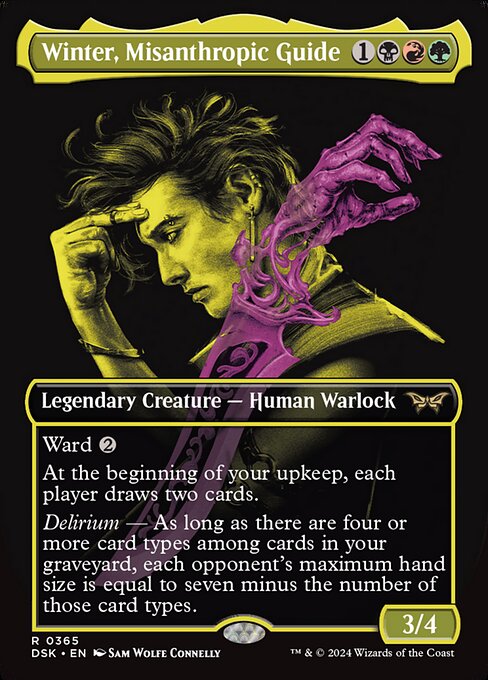


 Legendary Creature — Human Warlock